
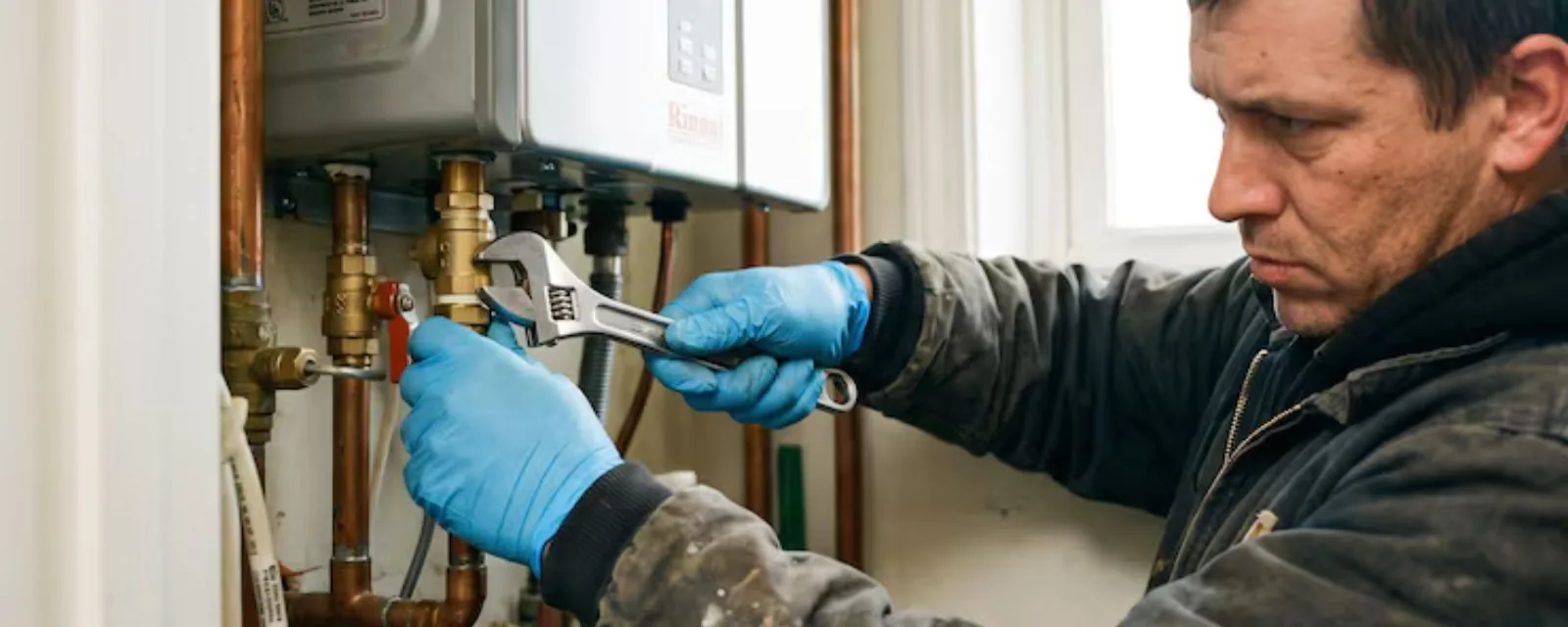
If your water heater is dripping, pooling water on the floor or has quit heating, call now. Emergency water heater repair in Holly Springs means a licensed plumber finds the fault, tells you whether a repair is worth the money, and quotes a clear price before work starts. Our dispatch line is open 24/7, so a Saturday night leak gets the same attention as a Tuesday morning one.
The two things that matter most in the first few minutes are the water and the fuel. Stop the water feeding the tank, cut the power or gas, and read the safety note below before you touch anything else.
Smell gas? Leave first, call us second
If you smell gas near a water heater, or you hear hissing near the gas line, do not flip switches, light anything or use your phone inside. Walk everyone out, then call your gas utility or 911 from outside. Dispatch will schedule a licensed plumber once the utility says the building is safe, and we never promise a response time on a gas smell.
Water around the tank or no hot water at all
These are the two situations that send people to the phone. They look alike from the hallway, but they come from different faults and they carry different risks.
A puddle means water is escaping, and every hour it keeps escaping adds damage to flooring, drywall and whatever is stored nearby. No hot water means the heater is not heating, which is a nuisance but rarely a hazard. Lukewarm water, water that runs hot for a minute and fades, and rumbling noises sit in between.
- Water on the floor: act immediately, shut off the cold supply and the power or gas
- Rusty or brown hot water only: the tank interior may be corroding
- Hot water gone on an electric heater: check the breaker and the reset button first
- Pilot flame out on a gas heater: relighting is fine once, but a pilot that keeps dying means a failed part
- Popping or banging from the tank: sediment or a failing element, not an emergency by itself
The first ten minutes with a leaking heater
Do these in order. None of them needs tools beyond a flashlight and maybe a bucket.
- Find the cold water shutoff on the pipe entering the top of the tank and turn it clockwise until it stops. If it will not budge, use the main valve where water enters the house.
- Electric heater: switch off the dedicated breaker. Gas heater: turn the gas control knob to off, or close the gas valve on the supply line only if you smell no gas.
- Open a hot tap somewhere in the house so the tank does not build pressure while it drains.
- Move boxes, rugs and anything cardboard out of the puddle, and put a bucket under any steady drip.
- Do not touch the floor water if the heater is electric and standing water reaches the unit. Stay out until the breaker is off.
- Look at where the water comes from. Dripping from a pipe fitting on top is a different repair than water seeping from the bottom of the tank jacket.
Tell dispatch what you see and whether the unit is gas, electric or heat pump. We will explain the visit and the price before any work begins.
Gas, electric or heat pump: what usually fails
Each type heats water differently, so each has its own short list of troublemakers. This table shows where a technician starts looking.
| Heater type | No hot water | Lukewarm or short hot supply | Leak or noise |
|---|---|---|---|
| Gas tank | Pilot out, thermocouple, gas control valve, blocked vent | Dirty burner, sediment, broken dip tube | Tank corrosion, drain valve, relief valve |
| Electric tank | Tripped breaker, tripped high-limit switch, dead upper element | Dead lower element, thermostat set low, crossed supply lines | Loose element gasket, tank failure, relief valve |
| Hybrid heat pump | Control board fault, compressor lockout, both backup elements dead | Dirty air filter, tight installation space, heat pump mode too slow | Clogged condensate line, tank failure, relief valve |
| Any type | Closed or partly closed supply valve | Mixing valve or thermal expansion trouble | Fitting leak at the top connections |
Gas heaters: pilot light, thermocouple and burner
A standing pilot flame heats a small sensor called a thermocouple. When the sensor stays hot it tells the gas valve to stay open, and when the flame goes out the sensor cools and shuts the gas. A worn thermocouple cools too early, so the pilot lights, drops out after you release the knob, and refuses to stay on.
Thermocouples are one of the cheaper parts in the whole unit, but the diagnosis matters. A pilot that blows out can also mean a draft, a partly blocked flue or a failing gas control valve, and swapping the wrong part wastes your money. Many newer gas heaters use electronic ignition with no standing pilot, so the fault list changes to ignitor, flame sensor and control board.
Soot on the burner, scorch marks around the draft hood or a yellow flame instead of blue are warning signs. Shut the heater off and call, because those point to poor combustion and a venting problem.
Electric and heat pump heaters: elements, thermostats and condensate
A standard electric tank has two heating elements, one near the top and one near the bottom, each with its own thermostat. If the top element dies you get nothing, and if the bottom one dies you get a short burst of hot water and then cold. A multimeter tells us which part has failed in a few minutes, and a stuck high-limit reset button usually has a cause behind it, not just a bad day.
A hybrid heat pump heater moves heat from the surrounding air into the tank, with electric elements as backup. It also drips condensate, like an air conditioner, so a wet floor under one is not always a tank failure. We trace the drain line first, then the tank, then the fittings.
Heat pump models need open air around them and a clean filter. If yours sits in a closet or crowded utility room, tell dispatch, because airflow can explain slow recovery. For a long-term upgrade, our water heater installation page covers where and how these units are set.
How a technician finds the real fault
A repair is only as good as the diagnosis behind it. This is the order we work in.
- 1
Read the data plate and the history
The label shows fuel type, capacity and often the manufacture date. We ask when the problem started and what changed, such as a power outage, a recent storm or a remodel.
- 2
Test before we replace
We use a multimeter on electric elements and thermostats, a manometer and combustion check on gas units, and a flashlight with a dry paper towel to trace drips back to their source.
- 3
Separate fitting leaks from tank leaks
Water running down from the top connections or relief valve line can look like a failing tank. We dry everything, then watch where the first bead of water forms.
- 4
Quote the repair and the alternative
You hear the cost of the repair and, when the unit is aging, the cost of replacing it, before any part comes off the truck.
Relief valves, sediment and the tank itself
The temperature and pressure relief valve is a safety part, not a nuisance. If it drips steadily or discharges a burst of water, something is wrong, usually pressure that is too high, a thermostat that is set too hot or a valve that has simply worn out. Never cap or plug the discharge pipe. A technician can replace the valve and check for thermal expansion in the house plumbing, which is the more common cause.
Sediment settles at the bottom of the tank over the years. It makes pops and rumbles, insulates the water from the burner or lower element, and wastes energy. A flush can help on a tank that is still sound, but it will not fix a tank that has already started to corrode.
A tank leak is different from a fitting leak. If water seeps from the base, the metal tank has rusted through, and no repair will hold. If a leak starts at the cold inlet, hot outlet, drain valve or relief valve, there is a decent chance a repair is worth doing.
Repair or replace: an honest decision table
We would rather tell you to replace than sell you a repair that fails in a month. Use this as a guide, and expect us to say which row you are in after the inspection.
| Situation | Repair usually makes sense | Replacement usually makes sense |
|---|---|---|
| Leak from a fitting, valve or drain | Yes, if the tank is dry and sound | If the fitting threads are corroded into the tank |
| Leak from the tank body or base | No, the tank has failed | Yes, see water heater replacement |
| No heat, one bad part | Yes, if the unit is not old and parts are available | If the unit is in its second decade or the part costs close to a new heater |
| Rust-colored hot water only | Maybe, the anode rod may be spent | If rust also shows at the tank base |
| Repeated repairs in one year | Rarely | Often, the next failure is usually close behind |
What affects the price of a water heater repair
We give a clear price before work starts, and these are the things that move it. Homeowner insurance typically does not pay to fix a worn-out water heater, though some policies cover sudden water damage from a leak. Check your policy or call your agent.
Which part failed
A thermocouple, element or thermostat is a small repair. A gas control valve, heat pump control board or compressor is not.
Fuel type and model
Gas, electric and hybrid units use different parts, and some brands stock their parts more widely than others.
Age of the unit
On an older tank, a fix may be sound but not worth much, so we talk through replacement alongside it.
Access and location
A heater in an open garage is quick. One in an attic, crawlspace or tight closet takes longer and sometimes two people.
Time of day
After-hours visits can cost more than a weekday appointment, and we tell you before anyone is sent.
Want your real number? Describe what the heater is doing and give dispatch the model on the data plate if you can read it. We will walk you through what the visit involves before a truck rolls.
Water heaters and Holly Springs water
The Cherokee County Water and Sewerage Authority (CCWSA) reports that Cherokee County water is very soft, at 16 mg/L as calcium carbonate. Hard water is generally defined as above 100 mg/L. For a tank that means limescale is less often the culprit here than age and corrosion, so a failing heater is more often a worn-out one than a scaled-up one.
That applies if your water bill comes from CCWSA. If your water comes from another utility, check that utility's water quality report before assuming anything about scale. CCWSA also notes that white flecks in hot water can come from a faulty dip tube inside a water heater, which is a real and fixable fault worth mentioning to us.
Permit rules vary, so ask the City of Holly Springs at 770-345-5536 before replacing a heater inside city limits. In unincorporated Cherokee County, including areas like Hickory Flat, the Development Service Center at 770-721-7810 handles plumbing permits. Georgia's minimum plumbing code is based on the International Plumbing Code (IPC) with Georgia amendments.
Related heater and plumbing help
If the repair conversation turns toward a new unit, read about planned installs or about moving to a tankless water heater. A heater that leaks because a nearby pipe is dripping may call for leak detection first. We also take calls from Canton when a heater fails at night.
Water heater repair questions
Do you handle water heater repair emergencies at night or on weekends in Holly Springs?
Yes. Dispatch is open 24/7 for leaking tanks, no-hot-water calls and failed heaters. Tell the dispatcher whether the unit is gas, electric or heat pump and whether water is on the floor, and they arrange the earliest appointment available. You hear the price before any work starts.
Why is my water heater leaking?
It is either a fitting or valve leak, which is often repairable, or a leak through the tank body, which is not. Turn off the cold supply and the power or gas, dry the area and watch where the first drops form. A leak from the base of the jacket usually means the tank has rusted through.
Why do I have no hot water?
On an electric heater, check the breaker and the red reset button on the upper thermostat. On a gas heater, see whether the pilot is lit. If a reset or relight does not hold, a failed element, thermostat, thermocouple or gas valve is the likely cause.
Can I relight the pilot light myself?
If there is no gas smell, the manufacturer's instructions on the heater label show how. If the pilot will not stay lit after one careful try, stop and call. Repeated attempts do not fix a worn thermocouple.
Is a dripping relief valve dangerous?
It can be. The valve opens when pressure or temperature is too high, so a drip is a warning. Do not cap the pipe. Call and have a licensed plumber check the valve, the thermostat setting and the house water pressure.
Does water hardness damage my heater in Cherokee County?
CCWSA reports very soft water here, so scale buildup is less common than age and corrosion. If your water comes from a different utility or a well, check that source's water report or test your tap.