
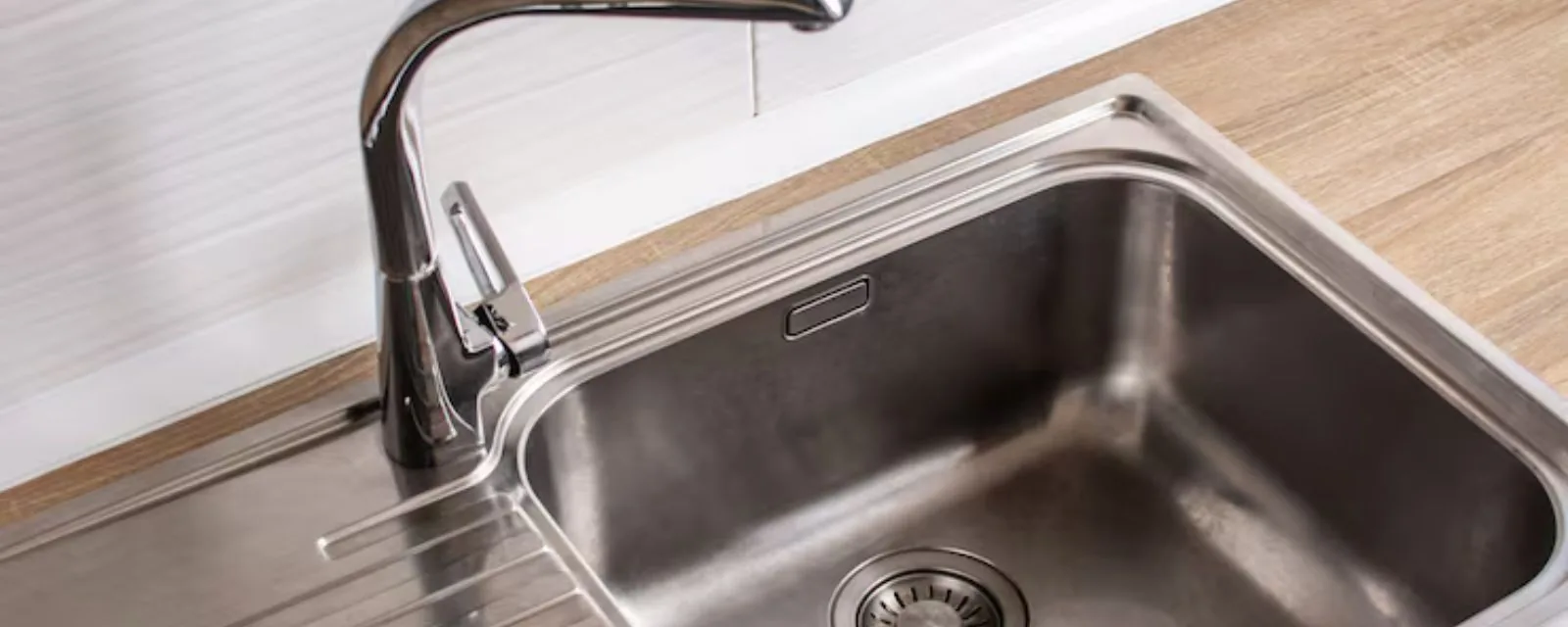
A garbage disposal that will not spin, hums and stops or drips into the cabinet usually needs attention the same day, especially in a kitchen that is in use. Emergency garbage disposal repair in Holly Springs starts with our 24/7 dispatch line, and a licensed plumber is sent as soon as one is free. You hear the price before work starts.
Before you call, switch the disposal off at the wall and keep your hands out of the sink opening. The safe checks below cover the most common jams.
Disposal jammed or flooding the cabinet? Safe first steps
Power off, hands out, then look for the simple cause. These steps fix a surprising number of jams.
- 1
Turn off the switch and unplug it
Flip the wall switch off. Then reach under the sink and unplug the cord, or switch off the circuit breaker if the unit is wired in. A disposal that starts while you work can cause serious injury.
- 2
Turn the blades by hand from underneath
Look at the bottom of the disposal for a small hex-shaped socket in the center. Fit the hex key that came with the unit, or a one-quarter-inch Allen key, and work it back and forth until it turns a full circle.
- 3
Remove what jammed it from above
With the power off, use tongs or pliers and a flashlight to lift out the spoon, bone or bottle cap. Never reach into the opening with your hand.
- 4
Press the red reset button
There is a small red button on the bottom of the unit. It pops out when the motor overheats. Wait a few minutes, press it in, restore power and test with a little cold water.
Humming but not spinning
A steady hum with no movement means the motor has power but the blades are stuck. The hex key step above frees most of these. If the blades turn easily by hand and the unit still only hums, the motor or its starting capacitor may have failed, and that is a replacement.
If there is no hum and no movement at all, check the reset button, the breaker and the outlet. A disposal that trips its breaker again as soon as you turn it on has a shorted motor and is done.
Tell dispatch where the water appears and whether the unit hums. We will explain the visit and the price before any work begins.
Where the water is coming from
Run a little water and watch. Dry the unit first with a towel so you can see the first drop.
From the sink flange at the top
Water at the ring where the sink meets the disposal means the flange seal or mounting has loosened. The fix is to reset the mount with new plumber's putty or a gasket.
From the side or bottom of the body
A leak from the unit's housing or a hairline crack in the casing cannot be repaired. This is a replacement, because rust and wear have gone through the shell.
From the drain pipe connection
A weeping joint on the elbow that leads to the sink trap can often be fixed by tightening the connection or replacing the gasket. It is a modest repair.
From the dishwasher hose
A loose clamp on the small hose that feeds in from the dishwasher can drip under the sink and look like the disposal itself.
A clog in the disposal or in the sink drain
A disposal that grinds fine but leaves the sink full of water has a drain problem past the unit. Grease and food fibers build up in the trap and the pipe behind it. Running the disposal harder only pushes more material into the same restriction.
If both sides of a double sink are slow, or the dishwasher backs up into the sink, the clog sits in the shared branch line. Our drain cleaning page covers how those lines are cabled. We check the disposal and the drain at the same visit so you are not called back for the second problem.
What can go down, and what cannot
A disposal is a grinder for soft scraps, not a trash can. These rules protect both the motor and your drain.
| Item | Safe for the disposal? | Why |
|---|---|---|
| Small soft food scraps | Yes, with cold water running | Cold water keeps fats solid so they grind and flush |
| Grease, oil and fat | No | It coats the pipe walls and hardens farther down |
| Coffee grounds and eggshells | Use sparingly | They settle into sludge and pack the trap |
| Fibrous items such as celery, corn husks and onion skins | No | Strings wrap the blades and clog the line |
| Pasta, rice and potato peels | No | They swell in water and form a paste |
| Bones, fruit pits and glass | No | They jam or dull the grinder |
Repair or replace the disposal
A disposal is a moving machine with a limited life. Age and the type of failure usually decide.
Repair is a fit when
- The jam clears and the motor spins freely
- The leak is at the flange or a drain connection
- The unit is fairly new and quiet
- A dishwasher hose or clamp is the real problem
Replace when
- The housing leaks or the casing is rusted through
- The motor hums with the blades free, or trips the breaker
- The unit jams repeatedly or grinds poorly
- It is more than about ten years old and failing
Installing a new disposal
A new disposal mounts to the sink flange with a snap ring, connects to the drain elbow and to power, and often connects the dishwasher hose. If the sink has no power at the cabinet, an electrician may need to add an outlet or a switch, and we will say so before starting.
A new dishwasher connection has one detail that trips up many installs. Most disposals have a knockout plug inside the dishwasher inlet, and it has to be punched out with a screwdriver and hammer before the dishwasher drains. If the plug is left in, the dishwasher will not empty. We take the plug out and fish out the piece.
Never put your hand in a disposal
A unit can start if someone flips the switch while your hand is inside, and the grinding parts can crush fingers. Use tongs, pliers or the hex key from beneath, and keep power off at the plug or the breaker the whole time. If you cannot see what is stuck, stop and call.
What affects the price of disposal work
We give a clear price before work starts. Insurance usually does not pay for a disposal that wore out, but a sudden leak that damages the cabinet may be covered, so ask your agent.
Repair or replacement
A jam clear or a flange reseal is smaller than a full unit swap.
The size and type of the unit
Motor strength and the way it mounts affect what fits your sink.
Electrical access
An outlet under the sink makes install simple. Adding one is extra work.
Whether the drain is also clogged
A blocked trap or branch line adds time beyond the disposal itself.
Time of the visit
Nights and weekends can be priced differently, and dispatch tells you before anyone is sent.
Want your real number? Tell dispatch what the unit is doing and how old it is, and we will walk you through the likely visit.
Disposals and septic systems in Holly Springs homes
Not every home in the area is on public sewer. If yours is on a septic system, a disposal adds grease and solids to the tank and may need to be used lightly or not at all. Ask the North Georgia Health District at 770-479-0444 before you buy one, since the answer depends on your tank.
For installation permits or electrical changes, ask the City of Holly Springs at 770-345-5536 if you are inside city limits. If a disposal call comes from the north end of the county, our Canton page covers that area as well. Georgia's minimum plumbing code is based on the International Plumbing Code (IPC) with state amendments.
Garbage disposal questions
Do you handle garbage disposal emergencies at night or on weekends in Holly Springs?
Yes. Dispatch is open 24/7 for leaking, jammed or dead disposals. Tell the dispatcher whether water is reaching the cabinet floor, and they will arrange the earliest appointment available. You hear the price before work starts.
Why is my disposal humming but not spinning?
The blades are probably stuck on something. Turn off power, then use the hex socket on the bottom of the unit to rotate them. If they free up and the unit still hums, the motor may be worn out.
Is a leaking disposal fixable?
It depends where it leaks. A loose flange or a worn drain gasket can be fixed. A crack or a rusted-through housing cannot, and the unit needs replacing.
Can I use chemical drain cleaner when the sink is clogged?
Please do not. Chemicals sit in the sink and splash when we open the trap. Tell the plumber if you already used one. A cable machine clears the line without chemicals. See drain cleaning.
Should I run cold or hot water through the disposal?
Cold water. It keeps grease solid, so it can be ground and carried away. Hot water melts fat that then re-hardens in the pipe.
Can I put a disposal on a septic system?
Ask first. A tank that receives food solids needs pumping more often. Call the North Georgia Health District at 770-479-0444 for guidance on your system.