
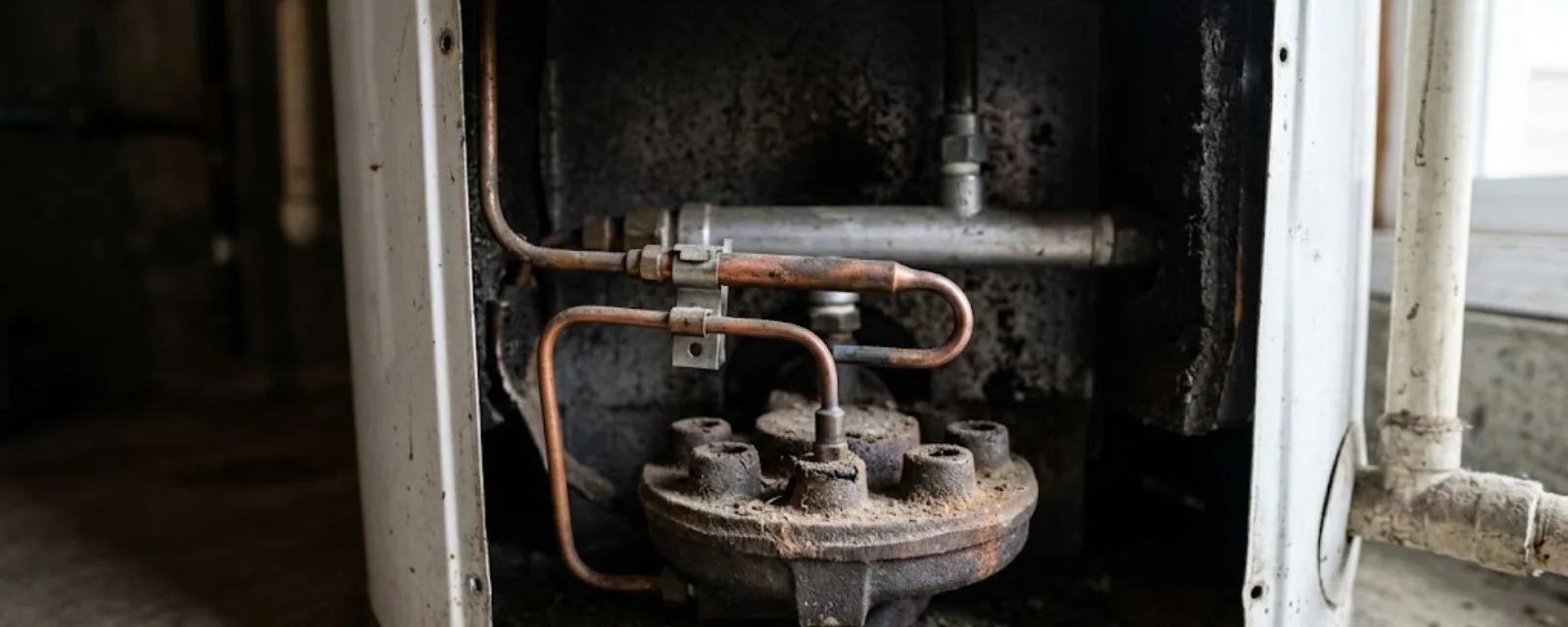
A thermocouple is a small heat sensor beside the pilot flame on a gas water heater. When the pilot stays lit, it produces a tiny electric current that tells the gas valve to stay open, and when the flame goes out, the current stops and the gas shuts off. If your pilot lights while you hold the button but dies the moment you let go, a worn or dirty thermocouple is the most likely cause.
Replacing one is a short job on many older heaters. It is not a job to try if you smell gas, and it is not the answer on every heater, because newer models often use electronic ignition with no standing pilot at all.
Gas smell comes first
If you smell gas near the heater, leave the building right away. Do not flip switches or use a phone inside. Call the gas utility or 911 from outside, and call a plumber only after the gas company says the house is safe.
Permits and night repairs in Holly Springs
Inside Holly Springs city limits, permit questions go to City Hall at 770-345-5536, and the answer depends on the exact work. A sensor swap is a different job from replacing the heater, so ask before you assume either way. Georgia's minimum plumbing code is based on the International Plumbing Code (IPC) with state amendments.
In unincorporated parts of Cherokee County, the county's Development Service Center issues permits only to state-licensed technicians and allows emergency work, with a broken water heater at night given as an example. The permit is then obtained as soon as possible and a final inspection follows, at 770-721-7810. If a heater dies after dark, that rule means the repair does not have to wait for the office to open.
Source type: county permitting department web page and city hall contact information
What the thermocouple does and how it fails
The sensor tip sits in the pilot flame. Heat on the tip creates a small voltage, and that voltage holds a magnet inside the gas control valve open. No flame means no voltage, and the valve closes. It is a simple safety device, and it is built to fail shut.
Over years the tip can burn thin, collect soot or bend away from the flame. A dirty pilot orifice, a sideways draft or a weak magnet in the gas valve can look the same from outside. That is why the first step is a diagnosis, not a part swap.
Signs that point to the thermocouple
These symptoms are typical of a failing sensor, though none of them proves it alone.
The pilot goes out when you release the button
You hold the knob down, the flame stays, and it dies a few seconds after you let go. The sensor is not generating enough current to hold the valve.
The pilot flame looks weak or yellow
A healthy pilot burns blue and wraps the tip. A lazy yellow flame can mean a dirty orifice, which affects both the sensor and the burner.
No hot water after a windy day or a draft
If the flame blows out and will not relight, check for drafts around the vent and base before blaming the part.
The heater has relit several times in a month
Repeated outages suggest a deteriorating sensor, a failing gas valve or a venting issue, not bad luck.
Tell dispatch what the pilot does and how old the heater is. We explain the visit and give a clear price before work starts.
What a homeowner can check, and where to stop
Reading the label and looking is safe. Opening gas fittings is not.
- Read the lighting instructions on the heater label, and follow the manufacturer's instructions exactly.
- Confirm the gas shutoff on the supply pipe is open and the heater control is not set to off.
- Check that the heater is gas. Electric models have no thermocouple.
- Look at the pilot flame once it is lit: blue and steady is healthy, yellow or flickering is not.
- Stop if the flame will not stay, if you see soot or scorch marks, or if anything smells like gas.
- Leave the gas control valve, burner assembly and gas fittings to a licensed plumber.
Pilot problems and what each one means
A new thermocouple fixes only the first row. The rest need more than a part.
| What happens | Likely cause | Typical next step |
|---|---|---|
| Pilot lights, dies when button released | Worn or dirty thermocouple | Clean the tip or replace the sensor |
| Pilot stays but burner never lights | Gas valve, thermostat or supply issue | Test the gas control valve |
| New thermocouple, pilot still drops | Weak gas valve magnet or drafty vent | Replace the gas control valve, check venting |
| Soot, rust flakes or water at the burner | Heater failing or venting problem | Inspect the unit, plan replacement |
| Heater is very old and keeps failing | General wear across several parts | Compare repair with water heater replacement |
Replace the sensor or the larger part
A thermocouple is a small, simple part, so it is the right first guess only when the symptoms fit.
Swapping only the thermocouple
- Fits the symptom of a pilot that dies on release
- Short job on a standing-pilot heater
- Fails again if the real fault is the gas valve
- Does nothing for a tank that is rusted or leaking
Replacing the gas valve or the heater
- Needed when a new sensor does not hold
- Makes sense when the tank is old, rusted or leaking
- Lets you move to a model with electronic ignition
- Costs more up front but ends repeat visits
What drives the cost of a thermocouple job
We give a clear price before work starts, and we cannot quote one here because the job is not always only a sensor. The number depends on the heater make and age, whether the correct part is available, how easy the burner compartment is to reach and whether the gas valve also needs work.
A heater in a tight closet or a crawl space takes longer than one in an open garage. If the diagnosis finds a failing tank, a repair may not be the sensible spend, and our water heater repair page explains how we weigh repair against replacement. Homeowner insurance seldom covers wear parts, so check your policy if water damage is involved.
What the visit looks like
- 1
Check for gas leaks first
Before touching anything, the plumber tests the fittings around the heater and the supply line.
- 2
Test the sensor
A meter reading shows whether the thermocouple creates enough current to hold the valve open.
- 3
Clean or replace
Soot is cleaned from the pilot assembly, and the thermocouple is replaced if it reads weak.
- 4
Relight and verify
The pilot is relit following the label, then the burner is cycled to confirm hot water and a steady flame.
Thermocouple and pilot questions
How do I know if my water heater uses a thermocouple?
Look for a small pilot flame you light by hand, usually behind a small window or access panel at the base. Heaters with push-button electronic ignition or a display often have no standing pilot. The label and manual say which type you have.
Is it safe to replace a thermocouple myself?
It involves a gas connection on many heaters, so we advise leaving it to a licensed plumber. If you smell gas at any point, leave the house and call the gas utility or 911 first.
Why does my pilot light go out again after a new thermocouple?
A new sensor will not help if the gas valve magnet is weak, the pilot orifice is dirty or a draft blows the flame out. A second failure calls for a valve check and a look at the venting.
Should I replace a thermocouple or the whole water heater?
Compare the heater's age and condition with the repair. A sound tank with a bad sensor is worth fixing. A rusted or leaking tank is not, and our plumber can tell you which you have.
Who do I ask about permits for water heater work at night in Holly Springs?
Inside the city limits, ask City Hall at 770-345-5536. In unincorporated Cherokee County, the Development Service Center at 770-721-7810 allows emergency work such as a broken water heater at night, with the permit obtained afterward and a final inspection.
Do you serve Canton and Ball Ground for water heater repairs?
Yes. Dispatch covers Canton and Ball Ground as well as Holly Springs. Dispatch is open 24/7.