
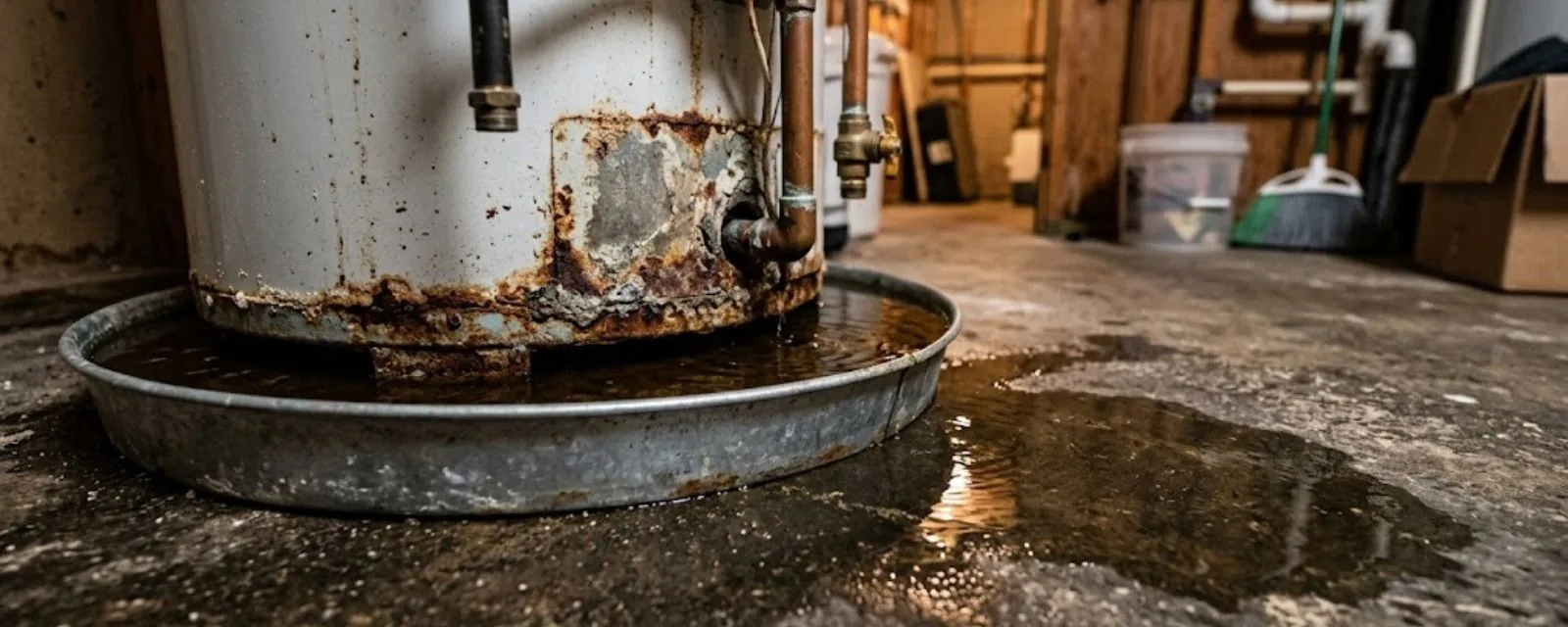
Short answer: a leak from a pipe fitting, the pressure relief valve or the drain valve can usually be repaired, and a leak from the tank itself cannot. The repair cost depends mostly on which of those it is, how old the heater is, and how easy it is to reach the part.
We do not publish a dollar range here because we would rather give you a real number for your heater than an average that fits nobody. This guide shows what moves the price, how to compare quotes, and what to do in the first few minutes while water is still on the floor.
Where the water is coming from decides the repair
Start by finding the wettest spot. Water that runs down the outside of the tank from the top usually comes from a fitting, such as the cold inlet, the hot outlet or a flexible connector. Those joints loosen, corrode or weep, and replacing a connector is a short job.
Water dripping from the discharge pipe beside the unit points to the temperature and pressure relief valve. It can be a worn valve, or it can be a sign that pressure in the house is running too high. Water at the bottom valve is often a loose or failed drain valve. Water that seeps out of the tank jacket or pools from underneath with no pipe above it is the bad news case, a tank that has rusted through.
One more look-alike is condensation. A cold tank in a humid garage can sweat, and a gas heater can drip a little while it first heats. A small amount of damp that dries on its own is not a leak.
Leak location and what it usually means
This table is a starting point. A plumber confirms with a dry paper towel, a flashlight and a look at the age plate.
| Where you see water | Likely cause | Usually repairable? | What changes the price |
|---|---|---|---|
| Top of the tank, at a pipe | Loose or corroded fitting or flex connector | Yes | Corroded threads, tight space |
| Drip from the relief valve pipe | Worn valve or high house pressure | Often | Whether pressure needs a separate fix |
| Bottom of the tank, at a valve | Failing drain valve | Often | Brass or plastic valve, sediment inside |
| Water pools under the unit, no pipe above it | Tank has rusted through | No | Replacement, not repair |
| Damp that dries on its own | Condensation | Nothing to fix | No charge for a part |
What the water report means for a leaking heater in Holly Springs
If your water comes from CCWSA, its 2025 Annual Water Quality Report describes Cherokee County water as very soft, at 16 mg/L as calcium carbonate. Hard water is defined as anything above 100. In practice, heavy mineral scale is rarely the cause of a leaking tank here, so ask the plumber about the heater's age and corrosion before agreeing to a descaling fix.
CCWSA also says it treats the water with orthophosphate to control corrosion in its distribution system, and the 2025 report lists no violations. That describes the utility's pipes and not the inside of your tank, so rust at the seams still points to a worn heater. Check your bill if you are unsure who supplies your water.
Source type: utility annual water quality report and utility water hardness page
What to do in the first 10 minutes
These steps limit damage while you wait for a licensed plumber. None of them needs a tool beyond a bucket and a towel.
- 1
Close the cold water supply
Find the shutoff valve on the cold pipe entering the top of the heater and turn it clockwise until it stops. If the valve is stuck or leaks, shut off the main water valve for the house instead.
- 2
Turn off the heat source
For an electric heater, switch off its breaker. For a gas heater, turn the gas control to off or pilot following the manufacturer's instructions. If you smell gas, leave the building and call the gas utility or 911 before you call anyone else.
- 3
Do not open the relief valve to test it
Hot water can scald, and a valve that has been sitting for years may not seal again afterward.
- 4
Contain and document
Put a bucket under any drip, move stored items off the floor and take clear photos of the wet area and the age plate. Photos help later with an insurer or a warranty claim.
Tell dispatch where the water is coming from. We will explain the likely repair and give a clear price before work starts.
What moves the cost of a leak repair
Costs vary because the parts are cheap and the conditions are not. We give a clear price before work starts, and these are the things that shape it.
Which part is leaking
A connector, a drain valve and a relief valve are separate parts with separate labor. A tank is a different job entirely.
Age and condition of the heater
An older heater with corroded fittings can break a fitting while it is being repaired, which turns a small job into a larger one.
Access
A heater in an open garage is quick to reach. One in a closet, attic or tight utility room takes longer.
Gas or electric, and venting
A repair that touches gas piping or a vent connection involves extra safety checks.
Water damage nearby
Wet drywall or flooring is a separate repair and may be an insurance matter, not part of the heater fix.
Want your real number? Describe the leak to dispatch and we will tell you what the visit involves before anyone is sent.
Repair the heater or replace it
A repair that is cheap today can still be the wrong call. This is how we think about it.
Repair is a poor bet when
- The tank body itself is leaking
- The unit is near the end of its normal life and rust shows at several fittings
- The leak has run long enough to rust the base or the burner area
- You are already facing a second repair on the same heater
Repair makes sense when
- The leak is a fitting, connector, relief valve or drain valve
- The tank is dry and sound when the part is removed
- The heater is otherwise working and sized for the house
- A new part solves the cause, not just the drip
How to compare quotes for a leaking heater
Ask each plumber to put the answers in writing. If the work becomes a replacement, our water heater replacement page explains the steps, and water heater installation covers venting and code details.
- The exact part that is leaking and how the plumber confirmed it
- Whether the repair fixes the cause or only the drip
- Parts, labor and any trip or after-hours charge listed separately
- What happens to the quote if the tank turns out to be the problem
- Whether permit rules apply to the work and who handles them
- Warranty terms on the part and on the labor, stated in writing
Insurance and what to photograph
Homeowner policies usually do not pay to replace a worn-out water heater. Many do cover sudden water damage to floors and walls, so ask your agent before you throw anything away. Keep the wet materials until they have been photographed.
Our water heater repair page covers service calls, and we also dispatch to Canton and Hickory Flat when a heater leak happens outside town.
Water heater leak questions
Can a leaking water heater be repaired?
Yes, if the leak comes from a fitting, connector, relief valve or drain valve. No, if the tank itself is leaking. A plumber can usually tell within a few minutes by drying the unit and watching where new water appears.
Is water from the relief valve pipe dangerous?
A steady drip means the valve is working or failing, and the pressure or temperature may be too high. Do not cap the pipe. Have it checked, since a blocked relief valve is a safety risk.
Should I shut off the heater when it leaks?
Yes. Close the cold supply, then turn off the power or set the gas control to off or pilot per the manufacturer's instructions. A gas smell means leave and call the gas utility or 911 first.
Will my insurance pay for a leaking water heater?
The heater itself is usually treated as wear and tear. Water damage that happens suddenly may be covered. Read your policy or ask your agent, and keep photos.
Does Cherokee County's very soft water mean scale is not my problem?
If your water comes from CCWSA, its 2025 report lists 16 mg/L as calcium carbonate, which is very soft. Scale is rarely the main issue, so tank age and corrosion matter more. A plumber looks at the age plate and the fittings to judge that.
How soon can someone look at a leaking heater?
Same-day appointments are offered when available. You hear the price before work starts.