
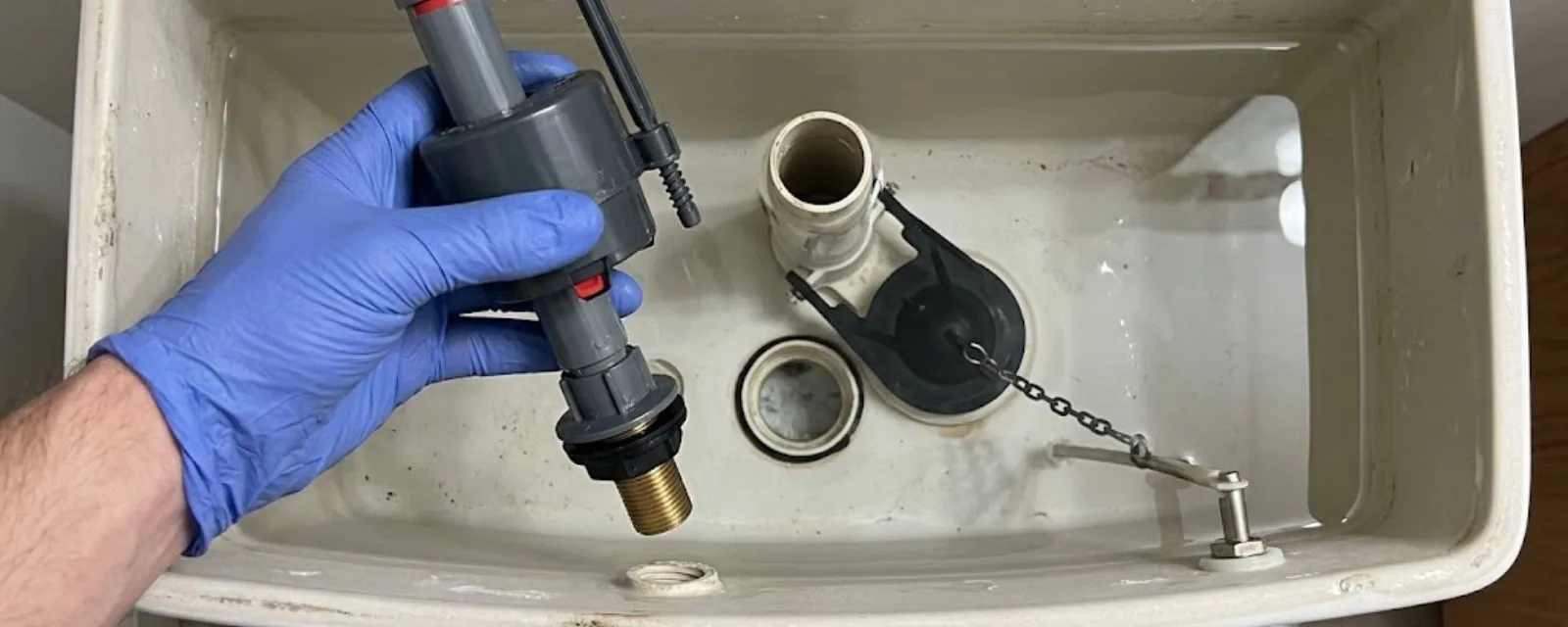
If your toilet keeps running, hisses after a flush or takes minutes to refill, the fill valve is the first suspect, but the flapper at the bottom of the tank causes just as many running toilets. A dye test and a look at the water level will tell you which part is failing in about ten minutes, and most fill valve problems need only an adjustment or a replacement part.
This guide uses a TOTO tank as the example, though the same logic applies to most two-piece toilets. Fill valve designs differ by model, so the label inside your tank and the maker's parts guide matter more than anything written here.
What the fill valve does, and why TOTO tanks need a careful look
The fill valve is the tall assembly on the left or right side of the tank. When you flush, its float drops, the valve opens and fresh water refills the tank and sends a small stream down the overflow tube to reset the bowl. When the float rises to the set level, the valve shuts off.
Some TOTO models use a fill valve shaped to fit that tank, and a generic universal valve may not seat the same way. Before you buy anything, find the model label or stamp inside the tank or under the lid, then match it against the manufacturer's parts guide. We cannot confirm a part number for your toilet from here, so treat the label as the authority.
Match the symptom to the part
Most running toilets fit one of these patterns. Start with the row that sounds like yours.
| What you notice | Likely part | First check | Usual fix |
|---|---|---|---|
| Hissing that never stops, water at the overflow tube | Fill valve not shutting off | Is the water level above the fill mark? | Lower the float, or replace the valve |
| Toilet refills on its own every few minutes | Flapper leaking into the bowl | Dye test with food coloring | Clean or replace the flapper |
| Tank takes a long time to refill | Partly closed supply valve or clogged valve inlet | Open the wall valve fully, flush debris | Clean the fill valve or replace it |
| Weak flush, water level too low | Float set too low | Compare water to the fill mark | Raise the float setting |
| Water on the floor near the base of the tank | Supply line, shank nut or tank bolts | Dry everything, then watch for drips | Tighten or replace the seal, or call a plumber |
Fill valves and water in Holly Springs
If your water comes from CCWSA, the Cherokee County Water and Sewerage Authority, the authority's own hardness page describes county water as very soft at 16 mg/L as calcium carbonate. In practice that makes a thick mineral crust on a fill valve less likely than plain age and wear, so a worn seal or sticking float is the better bet when a valve fails. Hard water is defined above 100 mg/L, so locally the usual cause is not scale.
CCWSA also publishes an annual water quality report. If you want to check what runs through your own tank, read the latest edition before assuming your water is the problem,. If your bill comes from another provider, ask that provider for its own report.
Source type: utility hardness FAQ page and annual water quality report
Describe the sound and the water level to dispatch. We explain the visit and give a clear price before work starts.
A ten-minute test sequence
Do these in order and you will rarely need to guess.
- 1
Look at the water level
Remove the lid. Water should stop about an inch below the top of the overflow tube, or at the fill line marked in the tank. Water spilling into the tube means the fill valve or float is the problem.
- 2
Run the dye test
Put a few drops of food coloring in the tank, do not flush, and wait fifteen minutes. If color shows up in the bowl, the flapper is leaking and the fill valve is probably fine.
- 3
Listen at the wall
Shut the wall valve, flush, and turn it back on slowly. A valve that screams or sputters may have debris in it, which a quick flush of the inlet can clear.
- 4
Adjust, then watch
Change the float height one small step, flush once and check the level again. Two or three tries is enough. If the level will not settle, the valve is worn.
Adjusting a fill valve versus replacing it
Adjustment costs a few minutes. Replacement takes longer but fixes the cause when the valve has simply aged.
Adjusting the existing valve
- Works when the water level is only a little too high or low
- Needs no parts and no shutoff beyond the wall valve
- Does not fix a cracked float, worn seal or sticking plunger
- The problem often returns within weeks if the valve is worn
Replacing the fill valve
- Fixes hissing, sputtering and valves that will not shut off
- Includes a fresh seal at the tank, where leaks often start
- Needs the right valve height and connection for your tank
- Takes longer, and a wrong fit can cause a new leak
Slow refills, noise and the water bill
A tank that refills slowly after every flush is often a supply problem rather than a bad valve. Check that the wall valve is fully open, that the braided supply line is not kinked, and that the valve inlet is not clogged with grit after a repair on the water main.
A toilet that runs quietly in the background can add to your water bill without making noise. If you have fixed the toilet and the meter still moves with every fixture off, the leak is somewhere else, and our leak detection page explains how we find it. For a stubborn case, our toilet repair team handles the whole fixture.
Before you replace any part
Spend two minutes on this list and you avoid a second trip to the hardware store.
- Read the model label inside the tank, and photograph it for the parts guide.
- Check the tank height from the base of the fill valve to the top of the overflow tube.
- Note whether the toilet is single flush or dual flush, since the flush parts differ.
- Turn the wall valve off and hold the flush handle down to empty the tank.
- Place a towel under the supply connection before you loosen the nut.
- Hand tighten new nuts, then a small turn more. Cracked tank porcelain cannot be repaired.
When to stop and call a licensed plumber
A fill valve swap is a reasonable weekend job. These situations are not.
The wall shutoff valve will not close
Forcing an old valve can break it and flood the room. A plumber can replace the valve and the supply line together.
The tank or bowl is cracked
A hairline crack in porcelain keeps growing. The toilet needs replacing, and plumbing installation covers that.
Water pools at the base of the toilet
Water at the floor can mean a failed wax ring. That job involves lifting the toilet and checking the flange.
The leak returns after a new fill valve
A second failure points to a fit problem, pressure issue or tank crack that a visual check can miss.
Toilet fill valve questions
How do I know if the fill valve or the flapper is the problem?
Do the dye test. Color in the bowl after fifteen minutes with no flushing means the flapper leaks. If the bowl stays clear but water runs into the overflow tube, the fill valve or float is the cause.
Can I use a universal fill valve in a TOTO toilet?
Sometimes, but not always. Tank shapes and valve heights vary, so check the model label inside the tank and the manufacturer's parts guide before you buy. If the sizes do not match, a plumber can source the correct part.
Why does my toilet fill slowly after I fixed it?
Look at the wall valve first, because a half-open valve slows everything. Then check the supply line for kinks and flush the valve inlet to clear grit.
How long does a fill valve last?
There is no fixed date. Rubber seals wear, floats crack and plastic stiffens, so a valve that hisses, sticks or will not hold a stable level is due for replacement regardless of age.
If my water comes from CCWSA, is hard water likely to be wrecking my fill valve?
Probably not. CCWSA describes Cherokee County water as very soft at 16 mg/L as calcium carbonate, so wear and age are more likely culprits than mineral buildup. The annual CCWSA report lets you check your own supply.
Do you repair toilets in Canton and Hickory Flat too?
Yes. Dispatch covers Canton and Hickory Flat along with Holly Springs, and you hear the price before work starts.