
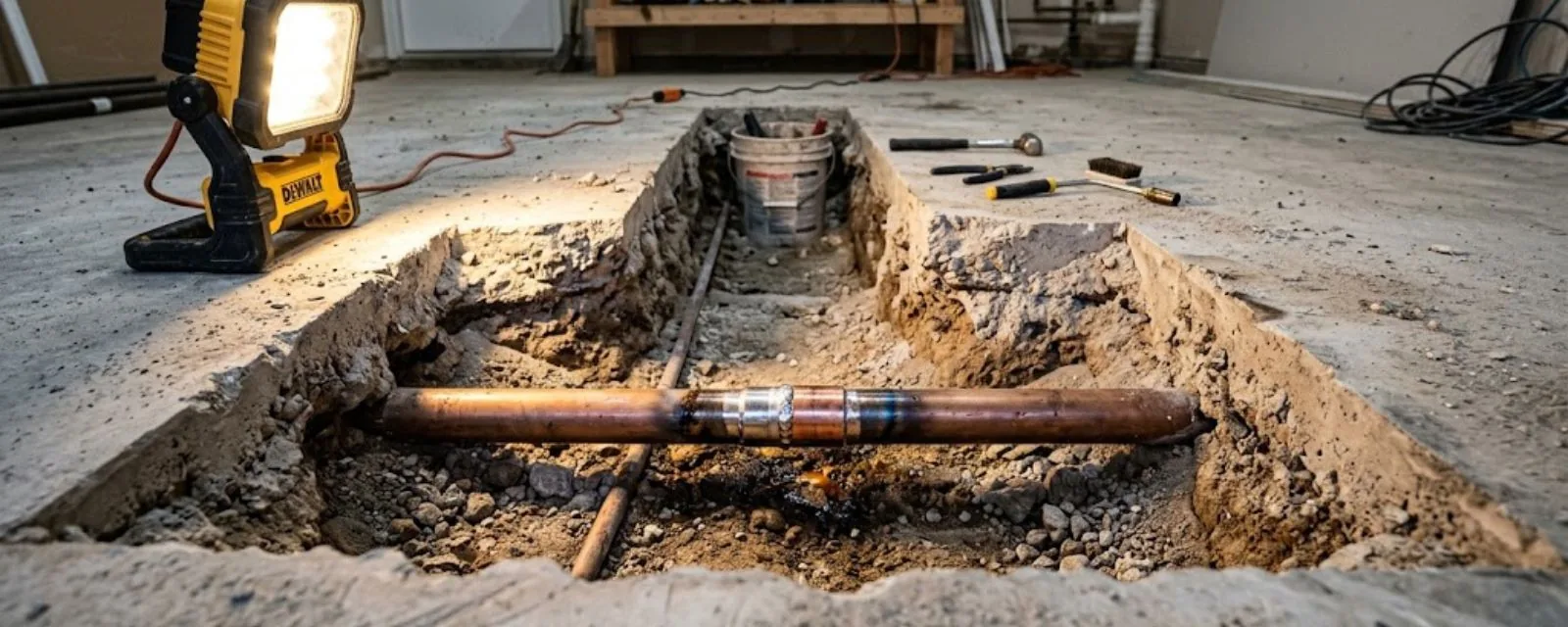
A leaking slab is repaired in one of four ways: opening the concrete and fixing the pipe in place, rerouting the line through walls or the attic, repiping the house, or lining the pipe from the inside. Which one fits depends on where the leak sits, how many breaks the line has and what pipe you have. Dispatch is open 24/7 if the water is already on the floor.
This guide assumes the leak has been found. It focuses on the repair itself, the order of work, floor restoration and the steps to take with your insurer.
Four repair routes at a glance
The right route balances disruption, how long the fix should last and how much of the system is worn.
| Route | How it works | Best when | Main trade-off |
|---|---|---|---|
| Spot repair | Cut the slab above the break and repair or replace that pipe section | One clear leak on an otherwise healthy line | Concrete and flooring are opened in that spot |
| Reroute | Abandon the slab line and run new pipe through walls or the attic | Pipes under the slab keep failing, or access is easy overhead | Walls or ceilings may need patching |
| Repipe | Replace the whole supply system with new pipe | Pipe material is failing in many places | The largest job, with the most disruption |
| Epoxy lining | Coat the inside of the pipe with a resin lining | Pipe is sound enough but leaking at pinholes | Not suited to severe breaks, and not every pipe qualifies |
Spot repair through the slab
This route starts with a marked cut in the floor. The plumber breaks out the concrete over the leak, exposes the pipe, replaces the damaged section and tests it under pressure before closing anything up.
It works well when there is a single failure in a good line. If the pipe has a history of leaks, patching one spot only moves the weak point down the line. See our slab leak repair page for how we assess that.
Call dispatch to talk through your options. We explain the repair and give a clear price before work starts.
Rerouting and repiping
Rerouting abandons the leaking line and runs a new one through the attic or inside walls. It avoids breaking more floor and gives you accessible pipe if something fails later. The drawback is patching drywall and painting where the new line passes.
A repipe replaces the supply system throughout the house. It makes sense when the original pipe is wearing out everywhere and you would otherwise chase one leak after another. Our repiping page covers what that project involves.
Emergency repairs and permits in Holly Springs
In unincorporated Cherokee County, the Development Service Center lets emergency plumbing work go ahead, and the permit must be obtained as soon as possible afterward, with a final inspection. The county's own example is a broken water heater at night. A slab leak that floods a room at midnight may be treated the same way, so ask your plumber to confirm how it applies.
That rule covers unincorporated areas, not city limits. If your address is inside Holly Springs, ask the City of Holly Springs at 770-345-5536 how permits work for emergency repairs. Ask early, because a final inspection can affect when you close up the floor. Georgia's minimum plumbing code is based on the International Plumbing Code (IPC) with state amendments.
Source type: county development service center permit guidance page
Epoxy lining and when it fits
Epoxy lining coats the inside of a pipe with resin so small leaks seal and the wall is reinforced. No concrete is opened except for access points. It is not a cure for every pipe, because it needs a line that is open, clean and not badly broken.
A plumber should show you the camera findings before proposing lining. If the line is badly corroded or has large breaks, rerouting or replacement is the honest recommendation.
How the repair job usually runs
The timeline depends on the route chosen, but the logic of the order stays the same.
- 1
Isolate and confirm
Water to the affected line is shut off and the leak location is checked once more before any cutting begins.
- 2
Open access
Furniture and flooring are moved, and a section of floor or wall is opened. Dust control and drying equipment go in if the area is wet.
- 3
Repair, reroute or line the pipe
The chosen fix is made and the line is pressure tested. Nothing is covered until the test holds.
- 4
Close up and dry out
Concrete is patched, and wet areas are dried before new finishes go down, because trapped moisture causes mold.
Floors, finishes and what happens after
A repair usually leaves a patched section of concrete and a gap in your flooring. Tile can be matched only if spare tile exists, and a plank floor may need a section replaced so the seams look right. Ask the plumber what finish work is included and what you must hire separately.
Plan for drying time. Wet subfloor, cabinets and baseboards need to dry before new flooring goes in. Skipping that step can bring back the smell, the swelling and the mold you hoped to be rid of.
What to do first: insurance claim steps for a leaking slab
Policies vary, so treat this as a sequence to follow, not a promise of coverage.
- Shut off the water to stop more damage, and take dated photos of every wet area.
- Call your insurer before repairs begin and ask what the policy says about hidden leaks and about locating the leak.
- Keep the plumber's written findings, the camera footage and the invoice.
- Ask what the policy treats as repair of the pipe and what it treats as water damage to the house.
- Save receipts for drying equipment and temporary housing if you need either.
Related work and nearby service
If the leak turns out to be outside the foundation, our water line repair page applies. We handle calls from Canton and Hickory Flat as well.
Leaking slab repair questions
Can a leaking slab be repaired without breaking the concrete?
Sometimes. Rerouting through the walls or attic avoids breaking the slab, and epoxy lining uses only small access points. Both depend on pipe condition and layout, so the camera findings decide.
How long does a leaking slab repair take?
A spot repair is often a matter of a day or two of work, while rerouting and repiping take longer. Drying and flooring can add more time. The plumber should give you the steps and sequence in writing.
Will the repair match my existing flooring?
Not automatically. Matching depends on whether you have spare tile or planks and on the age of the finish. Ask what restoration is part of the price and what is not.
Should I repipe the whole house after one slab leak?
Not always. If the rest of the pipe is in good shape, a targeted fix may be enough. If the pipe is failing everywhere, repiping can save repeated repairs.
Does an emergency slab leak repair in Holly Springs need a permit if it happens at night?
In unincorporated Cherokee County, emergency work may proceed and the permit must be obtained as soon as possible afterward, followed by a final inspection. Inside the city, ask the City of Holly Springs at 770-345-5536.